
Organizations today invest heavily in employee learning, but not all training approaches deliver the same results. The comparison between corporate training vs traditional training highlights why modern organizations are shifting toward more business-focused learning models.
While traditional training has long been the foundation of education and skill development, corporate training is designed to meet real workplace demands. Because business environments change rapidly, companies need training that directly improves performance, productivity, and adaptability.
At Career Craft, we help organizations move from generic learning models to practical, outcome-driven corporate training solutions.
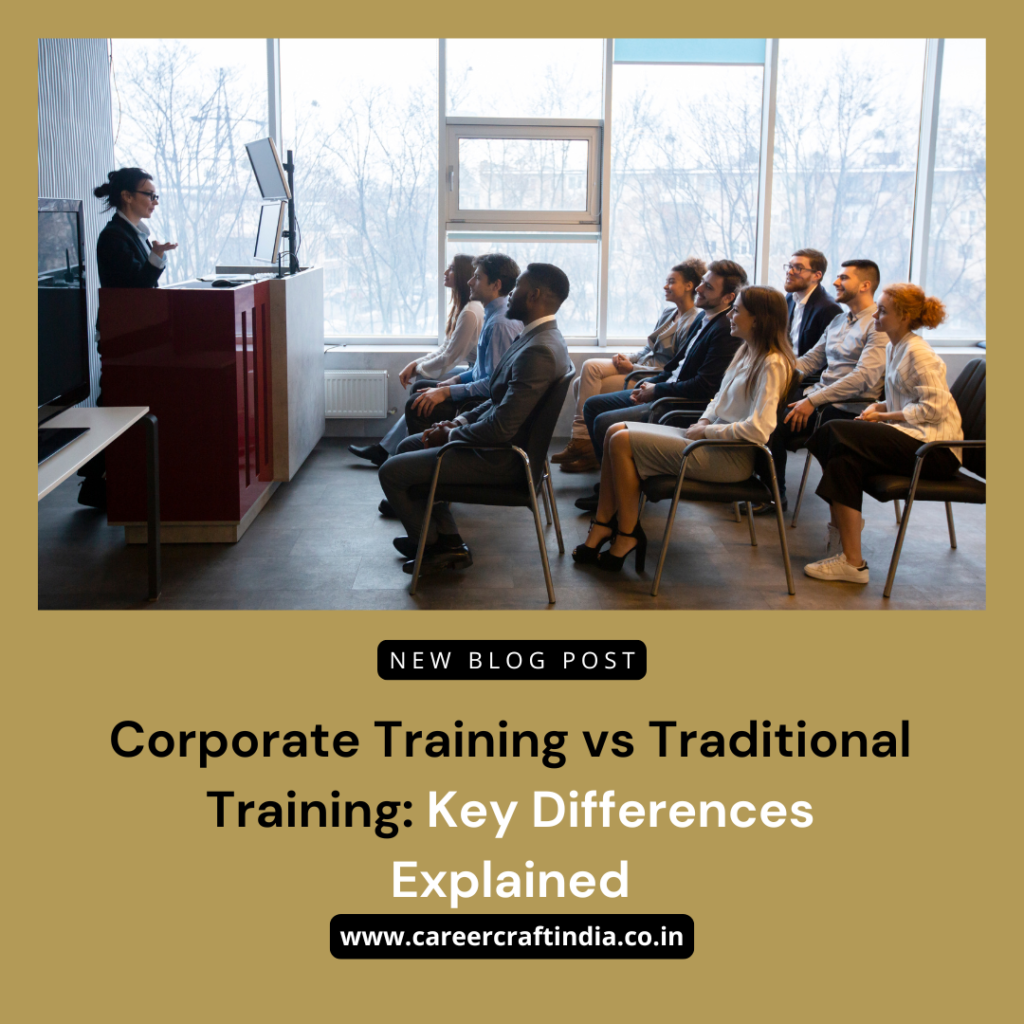
What Is Corporate Training?
Corporate training refers to structured learning programs designed specifically for employees within an organization. These programs focus on improving job-related skills, workplace behavior, leadership ability, and overall performance.
In addition, corporate training aligns learning outcomes with business goals. As a result, employees apply what they learn directly to their roles, leading to measurable improvements.
What Is Traditional Training?
Traditional training typically refers to classroom-based or academic learning methods. This approach focuses on theoretical knowledge, fixed curricula, and standardized assessments.
Although traditional training builds foundational understanding, it often lacks real-world application. Therefore, learners may struggle to apply concepts directly in professional settings.
Corporate Training vs Traditional Training: Key Differences
1. Purpose and Objective
Corporate training is designed to solve specific business problems. It focuses on improving performance, productivity, and workplace effectiveness.
In contrast, traditional training emphasizes general knowledge and academic understanding. As a result, it may not directly address organizational challenges.
2. Learning Approach
Corporate training follows a practical and application-based approach. Employees learn through real workplace scenarios, case studies, and hands-on activities.
On the other hand, traditional training relies heavily on lectures and theory. Because of this, engagement and retention can be lower.
3. Customization and Relevance
Corporate training programs are often customized based on organizational needs, job roles, and skill gaps.
Meanwhile, traditional training follows a standardized syllabus. Therefore, content may not always be relevant to specific job requirements.
4. Flexibility and Delivery Method
Corporate training offers flexible delivery formats such as online learning, blended learning, workshops, and on-the-job training.
In contrast, traditional training usually follows fixed schedules and classroom settings. As a result, flexibility is limited.
5. Focus on Skill Application
Corporate training emphasizes immediate skill application. Employees are expected to apply learning directly to improve job performance.
However, traditional training focuses more on knowledge acquisition than practical execution.
6. Measurement of Success
Success in corporate training is measured through performance improvement, productivity gains, and business outcomes.
On the other hand, traditional training success is typically measured through exams, grades, or certifications.
7. Target Audience
Corporate training targets working professionals, managers, and teams within organizations.
Traditional training primarily targets students or learners preparing for academic qualifications.
8. Alignment with Business Goals
Corporate training aligns directly with organizational strategy and growth objectives.
In contrast, traditional training may not consider specific business goals or industry needs.
9. Learning Duration and Continuity
Corporate training supports continuous learning and upskilling. Employees regularly update skills to remain relevant.
Traditional training often follows a fixed duration with limited follow-up learning.
10. Return on Investment (ROI)
Corporate training delivers measurable ROI by improving performance, reducing errors, and increasing retention.
Meanwhile, traditional training ROI is indirect and long-term, making it harder to measure.
Summary Table: Corporate Training vs Traditional Training
| Aspect | Corporate Training | Traditional Training |
|---|---|---|
| Objective | Business performance | Academic learning |
| Approach | Practical & applied | Theoretical |
| Customization | High | Low |
| Flexibility | High | Limited |
| Measurement | Performance & ROI | Exams & grades |
| Target Group | Employees & managers | Students |
Which Training Approach Is Better for Organizations?
For organizations, corporate training is far more effective. It addresses real challenges, improves employee capability, and supports business growth.
Traditional training still has value for foundational education. However, it cannot replace the impact of structured corporate learning.
According to McKinsey & Company, organizations that focus on skill-based, business-aligned learning outperform competitors in productivity and adaptability.
Source: https://www.mckinsey.com
Role of Corporate Training in Modern Organizations
Corporate training helps organizations:
- Build job-ready skills
- Improve employee engagement
- Develop future leaders
- Adapt to technological change
- Achieve long-term growth
Because of these benefits, corporate training has become a strategic investment.
How Career Craft Bridges the Gap
At Career Craft, we design corporate training programs that combine structured learning with real-world application.
Learn more about us:
👉 https://careercraftindia.co.in/about.php
Explore our corporate training solutions:
👉 https://careercraftindia.co.in/programs.php
Our programs are customized, practical, and aligned with organizational goals.
Frequently Asked Questions (FAQ)
What is the main difference between corporate training and traditional training?
Corporate training focuses on job performance, while traditional training focuses on theoretical knowledge.
Is traditional training still relevant?
Yes, for foundational learning. However, corporate training is more effective for workplace performance.
Can corporate training be customized?
Yes, corporate training is designed based on specific organizational needs.
Which training delivers better ROI?
Corporate training delivers higher and more measurable ROI for organizations.
How does Career Craft support corporate training?
Career Craft offers customized, outcome-driven corporate training programs.
Choose the Right Training Approach with Career Craft
Understanding corporate training vs traditional training helps organizations make smarter learning investments. While both have their place, corporate training delivers faster, measurable, and business-focused results.
Visit our website:
👉 https://careercraftindia.co.in/
Read more insights on our blog:
👉 https://careercraftindia.co.in/blog/
For customized corporate training solutions, contact us today:
👉 https://careercraftindia.co.in/contact.php